The following 'links and information' concerning Mesothelioma are dedicated to the many volunteers who worked at the WTC/911 and are dieing due to their inability to pay for medical treatment.
A few words from Doug Copp, a fervent patriot and yet a humanitarian who wants the best for America:
I highly recommend Michael Moore's documentary 'sicko' and endorse any and all Persons who propose that the United States provide Universal Medical Care for citizens.
The USA is the last western/civilised country, in the entire world, to provide Universal Medical Care.
Otto Von Bismark was responsible for Germany being the first country to provide Universal Medical Care.
He did this in 1883!
Universal Medical Care is now celebrating its 125 th year and yet the richest country, in World History, the United States of America, still allows people to die, in the street, from lack of medical care. Middle class families are driven to destruction from their inability to survive the catastrophe of sickness.
Surely, anyone of good heart must find this to be a disgrace. Haven't enough people died and enough people suffered? How is it possible for the richest country, in the world, to spend hundreds of billions of dollars every year, on continuous war, to profit weapons manufacturers and their political 'stoolies' and yet people are allowed to die in the street from lack of caring. Even the 911 volunteers who were used as 'political props', for phony patriotism, are dieing from lack of medical treatment.
Universal Health Coverage similar to 'Ending Slavery'.
For your information, the USA was the last western country, in the world, to end slavery. All other countries ended slavery volunteerly, without a civil war, from 1790 to 1825. The facts speak for themselves.
Some will call me a traitor for this recantation of these historical facts. In response, I want to bare my soul.
The Copp family arrived, in Boston, in 1635. Many of my ancestors fought for freedom. The America, in my heart, is worth standing up for. My America; includes, freedom, democracy and Universal Health Care as basic rights of all human beings who live in America.
Just as I have risked my life crawling into 894 collapsed buildings as an unpaid volunteer and have been maligned, harmed and received brutally harsh treatment as my reward for using the lessons I learned, to inform people of The Triangle of Life, to save their lives; I am willing to take any further abuse to keep my actions pure and ensynch with my heart.
For any person of good soul or good heart, towards their fellow human beings, the decision is a simple one.
This is NOT a 'political statement'. It is a humane statement. Right is right. Wrong is wrong.
doug copp
Mesothelioma & Asbestos Awareness Center
– After the attacks of 9/11, thousands of people including the rescuers, bystanders, and the victims were exposed to dangerous toxins like asbestos. Now, years after the disaster, people are starting to see the affects that these toxins have on the body. Mesothelioma & Asbestos Awareness Center specializes in speading information about the many aspects of mesothelioma, a disease caused by exposure to asbestos.
Mesothelioma, a disease cause by exposure to asbestos
Marc Murray of the M&AAC asked us to help. Please go to the ALL Volunteer 'Mesothelioma & Asbestos Awareness Center',website, for info.by clicking on the links above.
Here is an email from Richard Moyle of www.asbestos.com:
Attached are a couple pages of content on the asbestos risk associated with the World Trade Center attacks....
Thanks for teaming up with us to raise awareness about the health risks of asbestos.
Richard Moyle
Asbestos.com
When the World Trade Centers were attacked by terrorists on September 11th, 2001, our nation experienced one of the most devastating blows in American history. Families watched in horror as their friends and loved ones were lost in the collapsing of the twin towers. However, thousands of firefighters, policemen and volunteer rescue teams came together to save those trapped in the debris of ground zero. While these efforts to save lives were extremely heroic, many did not realize that the dust and debris from the collapsing of the towers spread poisonous contaminants through the air, including asbestos, a known cause of lung cancer and
mesothelioma.
First responders, survivors, workers who were hired to clean up ground zero, and those who lived in close proximity to ground zero were all exposed to the airborne toxins after the attack on the World Trade Centers. Since 9-11, countless people who were exposed to these toxins are suffering from symptoms of respiratory problems, including difficulty breathing, asthma, and different types of asbestos cancers,such as malignant mesothelioma. Not only were airborne toxins like asbestos, mercury, barium and lead found in the air, the buildings that were damaged during the attacks were aflame for nearly four months after 9-11, meaning that these and other heavy metals burned for a long period of time, releasing countless carcinogens into the air. As time since the attacks on the World Trade Center has passed, it has become obvious that many of our citizens have been infected with respiratory diseases and illnesses.
Although mesothelioma cancer is considered to be extremely rare, the only known cause is exposure to asbestos fibers. Asbestos is a naturally occurring fiber that has been mined historically because of its durability and resistance to heat. Historically, asbestos was used in throughout most of the 1900's in building and construction materials. While asbestos is not typically found in the air in quantities to be fearful of, after the attacks on the World Trade Centers the asbestos contamination rates in the air near ground zero were 93,000 times higher than the average amount of airborne asbestos found in other American cities, making risk of disease and illness extremely high. In January of 2008, preliminary findings of a study conducted by the New York State Department of Health were released. The study states that since 2001, at least 200 of the recovery workers and first responders have passed away, at least 55 of which were diagnosed with lung cancer. In fact, 62% of those people exposed to the dust and debris caused by September 11th report respiratory problems or complications.
When the construction of the World Trade Center was first initiated, the New York Port authority intended to use 5,000 tons of asbestos fireproofing in the first 40 floors of the building alone. However, while the construction of the buildings was in progress, the safety of asbestos containing materials was largely debated, and builders later decided to use less asbestos than they had initially planned. Additionally, after the construction of the towers was complete, more than half the original asbestos used was removed. While some debate that if the amount of asbestos used had been greater, the towers may not have collapsed as quickly as they did. However, using more asbestos would have resulted in even higher amounts of airborne asbestos fibers, making the after-effects of the attacks deadlier still.
Even after much of the asbestos had been removed, it was still one of the building materials used most frequently in the erection of the World Trade Center. When the towers collapsed, over 2,000 tons of asbestos fibers were released into the air. These fibers are microscopic in size and cannot usually be seen by the naked eye. Although workers who were hired to help clean up ground zero were advised to wear safety equipment and change their clothes before returning home, many of those who were exposed to the dust cloud and debris inhaled and ingested asbestos fibers unknowingly.
When asbestos fibers are inhaled or swallowed, they can frequently affect the mesothelial membranes in the body, or the protective lining surrounding many of the body's internal organs. Exposure to asbestos can cause mesothelioma. The most common types of the disease are pleural mesothelioma(cancer of the lining of the lungs), pericardial mesothelioma (cancer of the lining of the heart) or peritoneal mesothelioma(cancer of the lining of the abdomen).
When asbestos fibers enter into the body, they quickly become lodged in the body, and cannot be expelled. As time passes, irritation, inflammation and scarring may occur, and eventually the patient may notice symptoms of respiratory illness. Although the only known cause of mesothelioma is asbestos exposure, it takes several years for patients to notice symptoms of the disease, which usually include shortness of breath, chest pain, coughing and fever. In fact, symptoms of the disease usually are not present for 10-15 years after exposure, indicating that rescue workers and first responders at ground zero may not even be aware that they are suffering from complications due to exposure. Additionally, because of the ambiguity of the symptoms of the disease, mesothelioma can be difficult to diagnose, especially if patients do not inform their physicians of any previous asbestos exposure.
Although mesothelioma and other asbestos-related illnesses are considered to be rare, every year approximately 10,000 Americans die from these terrible illnesses. If you or your loved ones lived or worked near ground zero, or were first responders or recovery workers, and were exposed to the dust and debris after the September 11th attacks, it is important that you visit your physician regularly for health screenings and testing. Make sure your doctor understands of the possibility of asbestos exposure. When caught early, mesothelioma and other asbestos-related illnesses are manageable and can be treated more easily.
Additionally, workers who aided in the clean-up and rescue workers now have the option of taking part in the World Trade Center Medical Monitoring Program. This program is completely confidential and free, and will allow those who were exposed to the debris free health screenings and testing for the next five years. To become a part of this program,
please visit www.WTCExams.org. For more information on mesothelioma treatments or additional information on http://www.asbestos.com/world-trade-center/asbestos and the world trade center, please visit the Mesothelioma Cancer Center.
Statement from doug copp: "Please note that this WTC Medical Monitoring Program (referred to by Richard Moyle) does NOT provide treatment. It only monitors the statistics of illness and death".
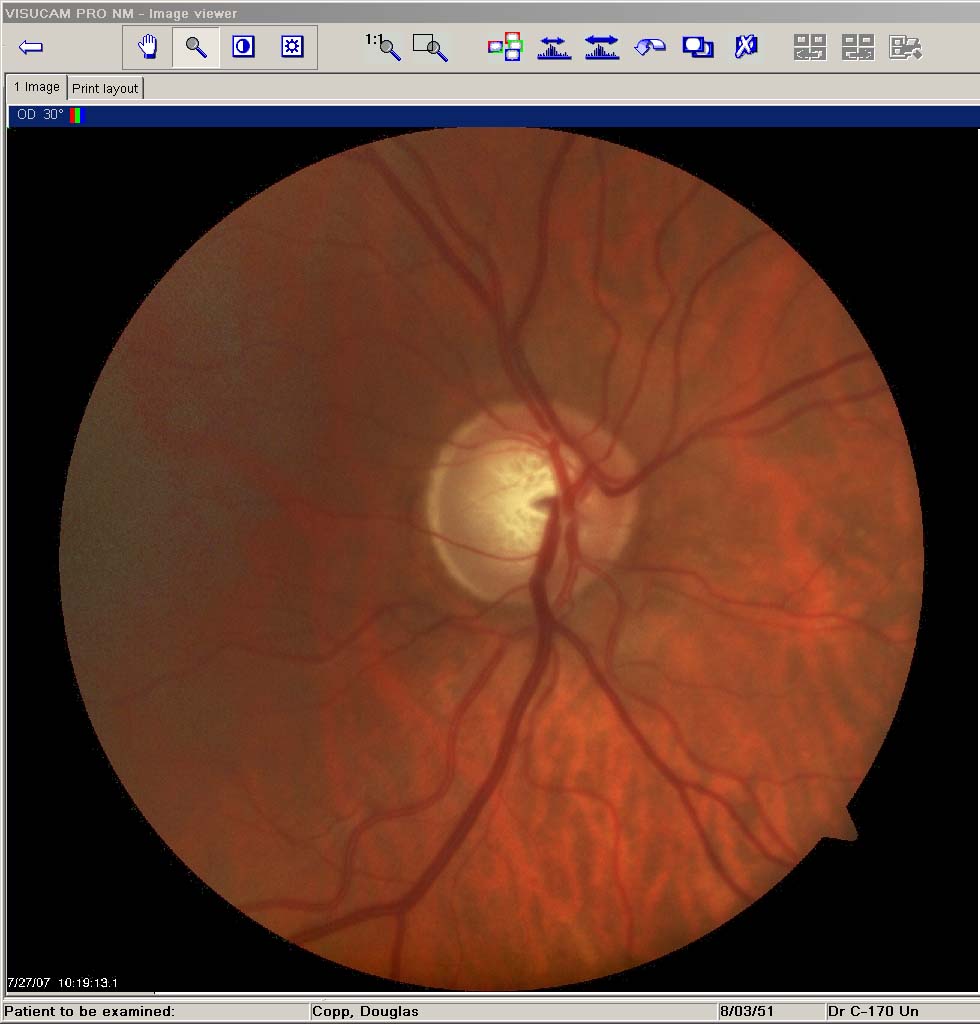
August 23, 2007. Medical Update. Here is one of the pictures of Doug Copp's deformed retinas photographed by Dr Bert Miller, Ophthalmologist, for Dr Monica Carrillo, Ophthalmologist.
Dr Carrillo is treating Copp for Glaucoma as a result of being poisoned at 9.11. The optic nerve stems are supposed to be perfectly round. The distortion in Copp's optic nerve stems is proof of damage by 9.11 toxins.
Copp, also, is being treated for Cerebral Edema (swelling of the brain) by Dr Timothy Smith and Dr Benjamin Boucher. The toxins from 9.11 cause elevated pressure in Copp's eyes because of his immune system being constantly challenged, by 9.11 poisons, in his blood stream.
Copp has been treated by 46 Medical Doctors, to date (feb 2008), for his 9.11 injuries. Copp's body, full of poisons, has had a maximum of 41 simultaneous medical problems. Currently, he is being treated by 6 Physicians for 15 X 9.11 medical problems; including, lesions in skin, acid reflux disease, coughing jelly-like mucous from his lungs, irritible bowel syndrome, hypothyroidism, cerebral edema, glaucoma,6 respiratory illnesses, immunological problems and many other illnesses. Copp is under constant medical care and medical testing for his 9.11 illnesses. Copp's health has deterorated past the point of his surviving a cure if he did have the money to pay for treatment which he never received. It is now too late for Copp.
Multi Billion Dollar Greed
The American Red Cross

Listen to the AmeriKa Now radio interview with doug copp, on the home page. You will be shocked and stunned by Doug's many revelations; including, the American Red Cross direct responsibility for 4,500 NYC first responders becoming injured at 911.
The President of 3 M Corporation told doug, personally, that 3M Corp donated $750,000 respirators to the American Red Cross
for distribution to first responders. The ARC kept these 'life saving respirators' in their wharehouses, for later sale.
Meanwhile first responders (without respirators) had a choice: take a chance or let the victims die.
The first responders; including, doug 'did the right thing' 'took a chance' and got poisoned The American Red Cross 'carpet bagged' more money;
as they have countless times before and continue to do so, today.
THE ARTI CREED: The Evil Forces Against Us: For Every Good Thing We Have Done an Equal To or Stronger Force of Evil Has Risen Up Against Us. We Fight On.
Did you know that the 'Heimlich Manuever', for saving choking victims, was invented by a Doctor named Heimlich? It is the accepted practice, ALL over the world. Today, it is taught by police, fire depts, hospitals and even the AMERICAN RED CROSS! For years, Dr Heimlich was vilified as a quack. His reputation was destroyed by the American Red Cross until they eventually accepted it and started teaching it! Triangle of Life///Doug Copp..same story?
Please Read:
Understand that Doug and ARTI have the greatest respect and admiration for the Red Cross and Red Crescent Organizations , around the world and feel the same about the International Red Cross. The American Red Cross is a completely different story. Read below and know why ARTI condemns the American Red Cross.
Doug Copp and ARTI have worked with the Red Cross and Red Crescent many times and at many disasters; since 1985. Doug has
been a member of the Mexican Red Cross since 1987. The Costa Rican Red Cross helped to give a parade for Doug , in
appreciation for his work at a giant Landslide in La Bomba. When in San Jose Doug trained the Costa Rican Red Cross and stayed at the home of the Red Cross Secretary General for a week. Doug has video of a Costa Rican Red Cross Official being interviewed on TV. When the Official is asked: "How can the Costa Rican Red Cross possibly complete the work at this giant Landslide when the British and Swiss Rescue Teams had left" , (refusing to work on the site because it was impossible and too dangerous). The Red Cross responded by stating: " because of rescue engineer Doug Copp". At this point, the camera panned over to the landslide and zoomed in on Doug, leading the rescue.
Doug has delivered medical supplies and incalculable truckloads of wheel chairs and crutches to Red Cross agencies in many cities in Mexico. Doug has trained the Red Cross in Ilo, Peru and dozens of other places throughout Latin America. Below, you will see some of the many letters of thanks from different Directors of the Red Cross, directed to Doug and ARTI. When the Mexican Red Cross asked Doug to request the American Red Cross to help them with expired medical goods and used equipment. The American Red Cross refused. So Doug and ARTI did the work. We helped the Mexican Red Cross when the American Red Cross refused.
At the World Trade Center the American Red Cross went nowhere near Ground Zero. There was no money to be raised at Ground
Zero. There were no TV cameras. ARTI crawled below the rubble while the American Red Cross collected 6 billion dollars in
extra cash beyond their usual multi billion dollar collection of donations. They still have most of that cash.
We have seen Mayor Art Agnos sue the American Red Cross who collected 57 million dollars to help the victims of the San
Francisco Earthquake only to spend $100,000 and try to 'get away' with the rest. Mayor Art Agnos sued them. ARC settled out
of court and spent the money on the victims. See the San Francisco Chronicle front page articles below.
Governor Jesse Ventura did the same thing when ARC tried to 'get away with' money raised to help Minnesota flood victims.
ARC has done this repeatedly. Remember all the media coverage about the ARC keeping the World Trade Center billions? Well
they kept the money.
Rocky Lopes, ARC Disaster Manager at he ARC National Headquarters (The San Francisco Chronicle refers to their huge marble
building as the 'Marble Palace') has sent out anti ARTI documents throughout the world, as far as Romania describing ARTI as
"only existing in the mind of Doug Copp". ARC continues to support duck and cover and to violently oppose the triangle of
life because their concern for the 6 billion dollars they raise every year is more important to them than the 200,000
victims who die every year from 'duck and cover'. They do not want their expertise questioned. Doug challenged ARC, in
writing, to produce a single picture of one of their 70,000 paid employees inside of a collapsed building and doug would pay
that person $1,000. They cannot produce a single picture because not one of them has ever crawled inside of a collapsed
building. The situation is the same as it was at the World Trade Center. ARTI members risk their lives crawling in the
rubble and ARC collects money to put in the bank.
A letter from the President of Safeway is below. I informed him of the ARC keeping the WTC money; including the millions
that Safeway employees donated. He was not happy. The worst scandal of all was that 3M Corporation donated $750,000.00 of
respirators to ARC for the World Trade Center. 4 thousand rescuers have respiratory illnesses because ARC refused to give
rescuers these respirators. Doug developed 5 different respiratory diseases because he could not replace his used up
respirator. This is a matter of medical records from some of the 25 Doctors and Medical Specialists who have treated Doug.
For 2 years Doug could only walk for 6 to 12 feet before starting to hyperventilate from lack of air. Thank you ARC.
Quotes from the CBS website:
...
"There's the fundraiser in Louisiana caught padding her own bank account with donations, the manager in Pennsylvania who embezzled to support her crack cocaine habit and the executive in Maryland who forged signatures on purchase orders meant for disaster victims, to name a few.
But the biggest criminal scandal inside the Red Cross surfaced in New Jersey last year. And though it's been kept off the front pages, it ranks among the biggest charity frauds ever.
At the center of the scandal is Joseph Lecowitch, chief executive of the Hudson County Chapter, and his bookkeeper Catalina Escoto.
Escoto allegedly gave herself at least $75,000 in bonuses. All told, prosecutors say the duo stole well over $1 million in Red Cross funds, squandering it on gambling and each other. Escoto pleaded not guilty. Lecowitch died after he was indicted."
- * Red Cross convicted of Fraud & Embezzlement * 4/7/2005
Associated Press.
Red Cross Director used donations for 911 victims for personal use. sentenced... see original article ,
Article
- American Red Cross agrees - Quake money will stay here,
clipping
- American Red Cross - mission in California,
clipping
- Oakland VS American Red Cross on Quake Aid,
clipping
- Red Cross: Sept 11 Fund Stirred Debate,
clipping
- Victims of Hugo echo S.F.: Red Cross a Disaster,
clipping
- Red Cross Chief Quits Amid Policy Disputes,
clipping
- Red Cross Sued Over Layoffs,
Article
- National Red Cross removes board of San Diego chapter,
Article
- American Red Cross Still Quaking,
Clipping
- CBS News reports Red Cross Theft,
CBS NEWS TV
- Toronto Star tainted Blood,
article
- San Francisco Examiner,
report from Mayor
- Daily Insight Magazine,
Red Cross theft
- more,
more
- fraud,
Red Cross theft
Red Cross Embezzlement
A former Red Cross official who admitted embezzling thousands of dollars from the donations given for the victims of 911. Federal Prosecutors got convictions for four felonies. "While serving as executive director of the Western Upper Peninsula Chapter of the Red Cross in 2001- 02, She used Red Cross money for personal things and submitted false financial reports to national and regional offices. Some of the money she took was from the "liberty fund" set up for the terrorism victims"
By The Associated Press
4/7/2005
Click here to see the original document
American Red Cross agrees - Quake money will stay here
"Of the $52.5 million donated, 12 million has been spent" , "The Red Cross gave in to heavy political pressure yesterday and agreed to spend all its donations earmarked for earthquake relief in Northern California"
By Kathy Bodovitz
San Francisco Chronicle
Click here to see the original document
American Red Cross - mission in California
"Local officials say just about the only quick response by the Red Cross was in asking for donations from the American Public, which responded with $144 million for the hurricane and the earthquake" , "bay area officials say they rarely could find Red Cross authorities when they were needed" , "Under a critical spotlight, the Red Cross then announced it would spend the rest of the earthquake donations in Northern California"
Click here to see the original document
Oakland VS American Red Cross on Quake Aid
"A coalition of Oakland community groups confronted American Red Cross officials yesterday, demanding an accounting of donations made to the organization for victims of the October 17th earthquake" , "They noted that President Bush is the Honarary chairman of the American Red Cross"
By Pearl Stewart
Chronicle East Bay Bureau
Click here to see the original document
Red Cross: Sept 11 Fund Stirred Debate
"And so far, there aren't alot of explanations coming that the average person who donated money is going to be happy about" , "The question is one of false advertising and whether people were led to believe something that wasn't true"
By Peter Y. Hong & Associated Press
New York Times
Click here to see the original document
Victims of Hugo echo S.F.: Red Cross a Disaster
"In it's response to both disasters, The Red Cross' relief efforts ranged from barely adequite to outright failure. Virtually everywhere Red Cross help was needed, the organization's performance was plagued by complacency, unprepardness, disorganization and shortages of supplies and trained personnel, according to senior officials, disaster experts and victims in the areas affected." , "In the case of Hugo, unlike the earthquake, there was advanced warning..."
By Jonathan Broder
Examiner Washington Bureau
Click here to see the original document
Red Cross Chief Quits Amid Policy Disputes
"American Red Cross President Bernadine Healy resined friday, saying she had been forced out by her board over policy disputes."
By P.J. Huffstutter and Scott Gold
Times Staff Writers
Click here to see the original document
Red Cross Sued Over Layoffs
"They were misled to believe they would receive severance payments when the Red Cross announced that massive firings would occur at the Holland lab, and then wrongfully denied severance payments after being terminated by the Red Cross"
By karl B. Hille
Examiner Staff Writer
Click here to see the original document
National Red Cross removes board of San Diego chapter
"I Think this is going to be damaging to the Red Cross," Said board Vice President Sharon Hilliard. "Anytime you have an organization taken over by edict from Washington, D.C., You have to be concerned about local control."
By Noberto Santana Jr. and David Washburn
Union-Tribune Staff Writers
Click here to see the original document
American Red Cross Still Quaking
"Agency accused of racism, financial irresponsibility" , "The charges include fiscal irresponsibility, racism, failing the public trust, arrogance and incompetence - They have forced major re-evaluations of the Red Cross' Role"
By Larry Hatfield
San Francisco Examiner
Click here to see the original document
The New Jersey fiasco, in which donations and government grants were all stolen, happened right under the nose of Red Cross headquarters. Critics say the reason the Red Cross has so little control over its chapters is that the chapters are pulling the strings: they collect most of the donations, dominate the national board and resist tighter controls by headquarters.
Click here to see the original document
Published on Monday, October 29, 2001 in the Toronto Star
Storm Brews Over Sept. 11 Funds
Now it appears the Red Cross will use millions of dollars raised on the basis of Sept. 11 for purposes that have nothing to do with the victims or their families. Instead, critics say, the Red Cross is using the money to expand its own empire.
Click here to see the original document
INDEPTH: TAINTED BLOOD
Tainted blood scandal
CBC News Online | May 30, 2005
On May 30, 2005, the Red Cross pleaded guilty to a lesser charge – violating the Food and Drug Regulation Act by distributing an adulterated or contaminated drug. The agency was fined $5,000 – the maximum penalty for the offence under the act.
The secretary general of the Red Cross delivered a videotaped apology to the courtroom, accepting the organization's responsibility for its role in the tainted blood scandal.
The agency also agreed to give $1.5 million to the University of Ottawa to fund a scholarship program for family members of those affected and a research endowment fund.
Click here to see the original document
February 12, 1990
Mayor Agnos demanded "a full, unadulterated public accounting" of Red Cross donations earmarked for earthquake relief. The Red Cross scandal was exposed by the San Francisco Examiner which charged that the agency collected more than $52 million, but spent just over $12 million on quake relief. Red Cross officials had previously said they collected only $26 million, but today admitted to a $52.5 million figure.
Click here to see the original document
The Red Cross in the Cross Hairs?
Posted on Oct. 12, 2001
By Kelly Patricia O Meara
In a time of national tragedy the true spirit of America shines through, and nowhere is this more evident than in the outpouring of extraordinary amounts of money for the survivors and families of victims of the Sept. 11 terrorist attacks. To date, nearly $800 million has been donated to various funds and charitable organizations. And the flood continues as every day it seems some new fund is created. While it now appears that donations are likely to go well over the $1 billion mark by the end of October, issues are being raised about how much of that will make it to those for whom this outpouring was intended.
Who or what is responsible for making sure this money gets to the intended recipients? Will it go to current victims and their families or will some go into larger portfolios for future crises? And how much of the collected funds will cover administrative expenses and fund raising or mailing-list prospecting?
To try to answer these questions Insight has been looking at what happened to the huge sums collected in the aftermath of the bombing of the Alfred P. Murrah Federal Building in Oklahoma City on April 19, 1995. While the families interviewed were reluctant to discuss the level of support provided them by charitable organizations, this magazine discovered a different picture than was (and is) being publicly portrayed.
For instance, Insight has learned that letters of condolence and donations sent through the U.S. Postal Service and deemed “undeliverable” often are turned over to charitable organizations involved in disaster relief. Sometimes mail would be addressed in care of a charity or fund. A case in point: the American Red Cross. The Postal Service received thousands of cards, letters and gift packages that were addressed, for example, to “the woman who lost two kids,” the “rescue dogs” or the “family who lost the little boy.” Both the Postal Service and the Red Cross have confirmed that within weeks of the bombings most of this mail was forwarded through the postal system to the Oklahoma City chapter of the American Red Cross where it was opened and read by volunteers. When possible, letters and packages were forwarded to the intended families.
Mike Ellis, the postal inspector in Oklahoma City at the time of the bombing, tells Insight: “These procedures will change post office to post office depending on the situation. There is no set policy. The Postal Service sat down with the American Red Cross, the Salvation Army and the governor’s and mayor’s offices, and it was decided the post office would deliver it if it was addressed to specific places and people and the Red Cross would take any undeliverable mail.”
“The Red Cross,” continues Ellis, “had volunteers who would open the mail, and if there were donations in the envelopes they would go into a general fund that the Red Cross had set up. The general fund was distributed to the victims at the time.” Three of four families directly affected by the bombing who spoke with Insight about the mail-delivery system acknowledged that all of the mail they received from the American Red Cross had been opened. More notable, however, is what these families reported about the surprising change in their mail deliveries after the American Red Cross took over for the Postal Service.
“The first days after the bombing,” says one family member, “people from all over the country were sending checks in lieu of flowers and we were getting a lot of checks and cash every day — hundreds, even thousands, of dollars. Then the Red Cross went down to the post office and made arrangements to collect the mail and they would deliver it to us in bulk. All the mail had been opened, and from that point on there never was a dime, even in letters that said money was enclosed.”
A member of another family recalls a similar experience: “We got this big box from the American Red Cross with more than 100 letters and each one of them had been opened. People told us that there was money in the envelopes, but we never got it. We heard that volunteers were opening the mail and putting the letters in one pile and the money in another. We complained to the Red Cross that it was mail fraud to open our mail. The letters, after all, were addressed to our family. We even went to local television stations asking them to do a piece on it, but they said it would make us look money-hungry. That wasn’t it, of course. We were upset that our mail was being opened. We were so angry we just blocked it out and moved on.”
One member of a third family recalls a large number of opened letters addressed to the family that it received from the American Red Cross but says, “We don’t think there was any suspicion that any money was removed in the mail. We didn’t see any of this.” The family did note, however, like the others, that money had been enclosed in the mail delivered to their home prior to the American Red Cross taking over distribution of the mail — but none was received afterward.
Formal complaints were lodged with the Postal Service and an investigation was conducted by Ellis, who in the process turned information over to the U.S. attorney in Oklahoma City. A grand jury needed to issue subpoenas to the Red Cross. It took testimony from a variety of individuals. Ultimately, as far as Insight has been able to learn, nothing came of the investigation. Bill Blaul, American Red Cross senior vice president for communications and marketing, tells Insight that his organization “cooperated with the U.S. attorney and he found no inappropriate handling of the matter, and it was closed.”
When asked to respond to the allegations that cash or checks may have been removed from the mail prior to its delivery to the intended parties, Blaul says: “The families may feel that way. I’m not sure what their memories and recollections are. The only motivation of the American Red Cross is to provide service to victims and families of the Oklahoma City and Sept. 11 attacks. We have no other motivation in opening individual mail.”
Insight then provided Blaul with specific instances where money apparently had been removed from envelopes clearly intended for a specific family. For instance, members of one family were so upset about what had happened to their mail that they wrote to people who had sent correspondence asking them to confirm whether a donation had been included. In one instance, a donor confirmed that $50 in cash had been sent along with the letter of condolence. The envelope delivered by the American Red Cross was addressed to the family through the Oklahoma City chapter of the American Red Cross. Despite the apparent intent of the donor to provide the enclosed money directly to the family, it did not receive it.
Asked about this specific example, Blaul becomes defensive and says, “I don’t know what more I can say about it. If mail is addressed to an individual we don’t open it,” he declares, contradicting what inspector Ellis told Insight. “I’m beginning to resent the implication that the Red Cross is opening mail and lifting money from the envelope,” Blaul insists.
Insight did not suggest anything untoward was or is going on in such cases. Rather, it followed up on questions raised by Oklahoma City families and victims who voiced concern about their mail and what they — and some donors — later learned about the handling of cash and other monetary donations. Specifically:
Cash donations may have been lost in the shuffle between and among agencies.
Checks made out to the Red Cross and intended for specific individuals didn’t always go to those individuals and weren’t returned to the donor.
Sometimes cash or checks went into a general fund for the Red Cross and then checks were delivered to the intended recipient.
Money received for intended relief work may not have gone directly to specified funds or charities but was absorbed into larger operating funds for future disasters.
Public accounting for how much money was received and then distributed is not readily available for public and/or press review and, apparently, not audited by government agencies.
Government funds established to receive funds for disaster relief and provide assistance did not make public “cash-in” and “cash-out” ledger records. And requests for such an accounting have not been provided.
All of which has raised disconcerting questions in the minds of many of those interviewed by Insight concerning the hundreds of millions of dollars pouring in to the New York City, Washington and Pennsylvania funds and charities working with the families and victims. For example, how are these groups cataloging the monies received, selecting individuals for disbursements and making sure that intended recipients of direct donations are, in fact, receiving them?
In the case of New York City, according to Blaul, “Thousands of pounds of mail is coming in and the American Red Cross is working with other agencies up there. We’ve got a room set aside for the mail that is coming in and we’re sorting through it. Where there are specific categories, such as firemen, we’re taking the mail without opening it and routing it to the appropriate sources. We’re not opening mail if it is addressed to individuals. The American Red Cross is doing this in a secure room with other entities and appropriate oversight.”
He does not elaborate on who or what those other entities might be.
Nor is Blaul able to provide Insight with the total amount of money received through this mail-review process. “I believe we are keeping track of only the money that is specifically meant for the Red Cross,” he says. He does not volunteer how much this amounts to, but published reports indicate the Red Cross thus far has received about $258 million in donations. How much other money Blaul’s organization has collected that was not “specifically meant for the Red Cross” could not be determined by press time.
How much ultimately was collected to assist the victims of the Oklahoma City bombing wasn’t available either. But, as a result of their own experiences, victim families of the Oklahoma City bombing have begun working with families touched by the Sept. 11 attacks. What advice have they for dealing with charitable organizations? “Don’t expect anything,” says one family, “and that way you won’t be disappointed.” Another family spokesman summed it up this way: “Oklahoma is doing great, but what about the New York families? I guess I’d tell them, ‘Don’t leave anything for someone else to do when it comes to your well-being.’ And I’d tell them to watch how the money is disbursed.”
Kelly P. O’Meara is an investigative reporter for Insight magazine.
and again: Quoted from the Holister Free lance Newspaper
NEWS
E-mail this article to a friend | Printer friendly format | Email The Editor
Former Red Cross Director Sentenced to Probation
Thursday, August 25, 2005
By Erin Musgrave/Staff Writer
Hollister - The former executive director of the Red Cross was sentenced Wednesday to felony probation and 120 days bound to an electronic monitoring device after pleading no contest to misusing chapter funds, according to her attorney.
Charron Contival pleaded no contest to the felony charge of misusing chapter funds in June after nearly three years of fighting the charge in the court system, said her attorney, Arthur Cantu.
Contival will be required to wear an electronic monitoring device on her ankle at all times and will be placed on felony probation for three years, Cantu said. She will be able to do some traveling as long as she does not remove the device, he said.
“This has been a long, grueling litigation and I don’t think she’s glad (about the outcome),” Cantu said. “She’s tired.”
District Attorney John Sarsfield charged Contival with embezzling more than $20,000 by misusing a Red Cross credit card, but Cantu insists it was no more than $2,500.
Sarsfield said when a dollar amount is determined she will be required to pay back the value of what was taken.
A conference has been scheduled for next week to arrive at a more precise figure.
"I think this was fair," he said. "It sends the appropriate message that money given to charity needs to be spent on the charity."
Contival headed San Benito’s chapter from about 2001 to 2002, and the original charge of misuse of funds was filed in October of 2003. The charge stems from Contival using chapter funds to purchase personal items for her home, which was being used as a satellite station for the Red Cross, Cantu said.
Click here to see the original document
|
Click Here to See
American
Red Cross
Double Cross

|
|
CLICK HERE TO SEE
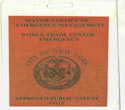
Doug Copp's official
WTC Emergency
(Badge #3119)
|
|
Under Construction!
This site is currently under construction, Updates are being performed daily, so please return often
|
|
Important Links and Articles |
|
|